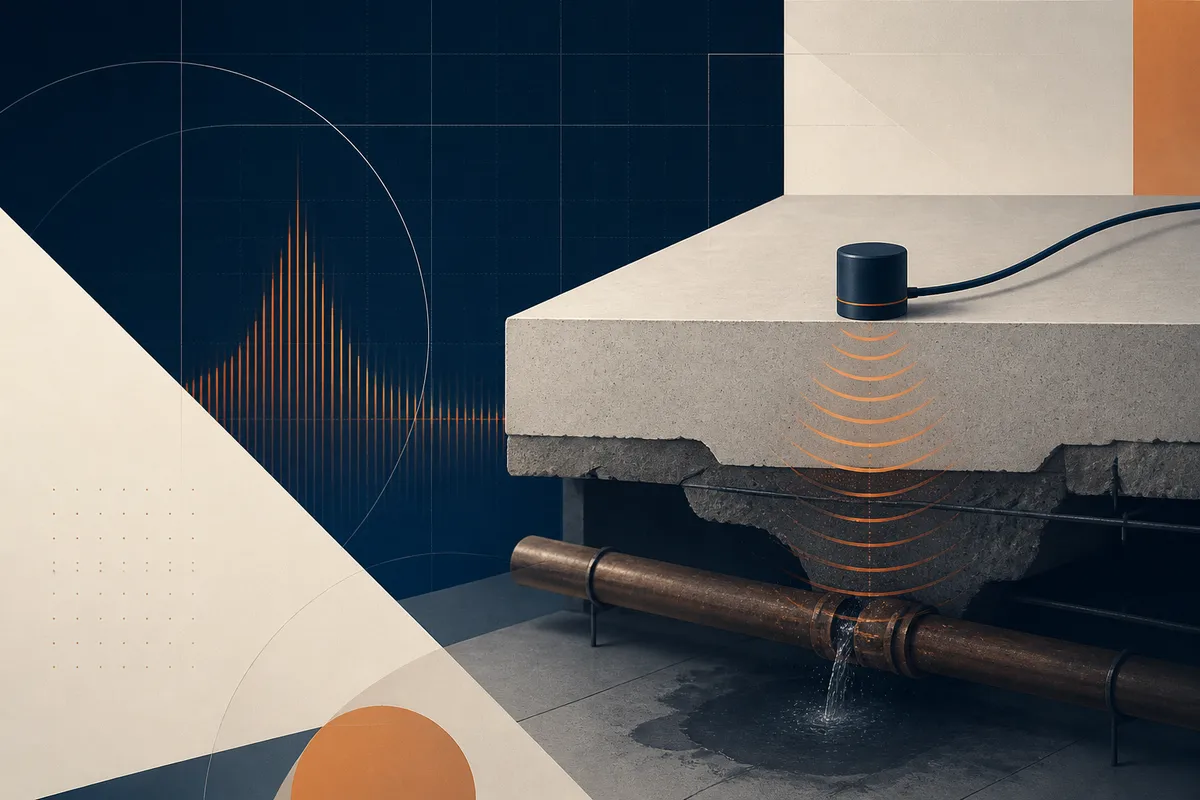
Hearing Through Concrete: The Physics of Acoustic Slab Leak Detection
Homeowners often assume a slab leak is a visual problem, but by the time water wicks through the flooring, the sub-slab damage is already extensive. In Phoenix, where slab-on-grade construction is the standard, the challenge isn't just finding the water; it is identifying the exact point of failure within a complex network of utility lines buried under reinforced concrete.
This guide breaks down how acoustic sensors and other non-invasive leak detection methods translate underground vibrations into actionable repair maps. By understanding the science of sonic frequencies, property owners can avoid the high costs of "blind" jackhammering and ensure their foundation remains structurally sound.
Why Visual Inspections Fail Under Concrete
Traditional plumbing diagnostics often rely on visible moisture, but water rarely surfaces directly above the pipe break. Gravity and soil compaction dictate the path of least resistance, which can lead water dozens of feet away from the actual leak.
- Concrete acts as a physical barrier that masks the sound of small, high-pressure pinhole leaks.
- Soil saturation muffles vibrations, often making a large leak sound quieter than a small, high-pressure spray.
- Ambient noise from air conditioners, traffic, and appliances can mimic the frequency of rushing water.
- Manifold systems under the slab create complex echo chambers that confuse basic listening devices.
The Framework for Precision Acoustic Mapping
Successful detection follows a rigid sequence of isolation and amplification to strip away background noise and zero in on the failure point.
1Pressure Testing and Isolation
Before any microphones are deployed, the plumbing system must be isolated. Technicians shut off the main valve and monitor the pressure gauge to confirm a drop, ensuring they are chasing an active leak rather than residual moisture. This step narrows the search to either the hot or cold supply line.
2Electronic Pipe Locating
Knowing where to listen is as important as the listening itself. Using electronic pipe locating tools, an operator traces the path of the metallic or tracer-wire-equipped lines beneath the slab. This ensures the acoustic sensor stays directly over the pipe, where the signal is strongest.
3Frequency Filtering and Amplification
Ground microphones are placed at intervals along the identified pipe path. These devices do not just "make things louder"; they use digital filters to block out low-frequency interference. Advanced signal processing and acoustic sensor designs are used to characterize and differentiate distinct leak sounds from normal water flow and background noise, as noted by Echologics.
4Triangulation of the "Peak"
The technician moves the sensor in a grid pattern. The sound of a leak creates a bell curve of intensity; the point where the decibel level peaks and the sound becomes "sharper" rather than "hollow" indicates the source. This precision allows for a surgical repair rather than a trench.
The Science of Sonic Propagation
Local foundations sit on a variety of soil types, from expansive clay to sandy loam. The density of the material surrounding the pipe significantly impacts how sound travels. In dense, dry soil, sound waves remain tight and clear. In saturated or loose soil, the sound disperses, creating a "ghosting" effect where the leak seems to be everywhere at once.
To combat this, professional acoustic kits often include "deck plates" or "ground spikes." A deck plate creates a wide surface area to catch vibrations traveling through tile or hardwood, while spikes can be used in exterior soft-scape areas to listen through the earth. According to the City of Phoenix, property owners should also regularly check for outdoor leaks around valve boxes, as these can sometimes mimic the sound of a sub-slab issue.
How Slab Leak Phoenix Helps
Managing a sub-slab failure requires a methodical approach that prioritizes the integrity of the home. A standard engagement begins with a comprehensive site assessment to identify the most likely failure points based on the home's age and layout. Once the leak is localized using acoustic sensors and thermal imaging plumbing scans, the resulting report provides the necessary data for a targeted repair. This may involve a localized patch, a pipe reroute to bypass the slab entirely, or a full system repipe depending on the condition of the existing infrastructure. For immediate assistance or to schedule a diagnostic visit, residents can reach the team at (602) 555-0147.
Frequently asked questions
Can acoustic microphones find leaks in plastic PEX piping?
Yes, but it is more difficult than with copper. Metal pipes act as better conductors for sound, allowing the vibration to travel further. With PEX or PVC, the sound stays localized, meaning the technician must place the microphone at much tighter intervals to catch the signal.
What does a slab leak actually sound like through the headset?
A high-pressure pinhole leak typically produces a consistent "hiss" or "whistle." A larger break might sound like a low-pitched "thump" or the rushing sound of a waterfall. Acoustic leak detection involves listening for the distinct sounds water makes as it escapes from pressurized pipes, according to LeakTronics.
Does the depth of the pipe affect the accuracy of the reading?
Depth is a significant factor. Most residential supply lines are within the range of professional acoustic equipment, but signal strength decreases as distance increases. If a pipe is buried significantly deeper, perhaps due to previous grading changes, the signal may be too faint to isolate without using specialized sensors or tracer gases.
Why not just use thermal imaging for everything?
Thermal imaging is an excellent secondary tool, but it has limits. It detects temperature differentials on the surface of the floor. If a leak is on a cold water line and the slab is already cool, or if the water is leaking deep into the ground without heating the concrete, the thermal camera won't see it. Acoustic detection is a primary method because it relies on the sound signatures of escaping water, as described by Water Softener Systems.
Is the house quiet enough during the test?
For the most accurate results, all water-using appliances must be off, and occupants should remain still. In some cases, if a property is near a high-traffic road, the detection may be performed during late-night or early-morning hours when the "noise floor" is at its lowest.
How accurate is the final location?
In ideal conditions with a skilled operator, acoustic detection can pinpoint the exact location of leaks in pressurized water pipes without excavation, according to GPRS. While no method is 100% infallible due to the way echos bounce off rebar and footings, it is exponentially more accurate than guessing based on surface moisture.
What happens when you get in touch: you describe the situation, the technicians ask the few questions that actually change the answer, and you get a clear scope and next step — no obligation.