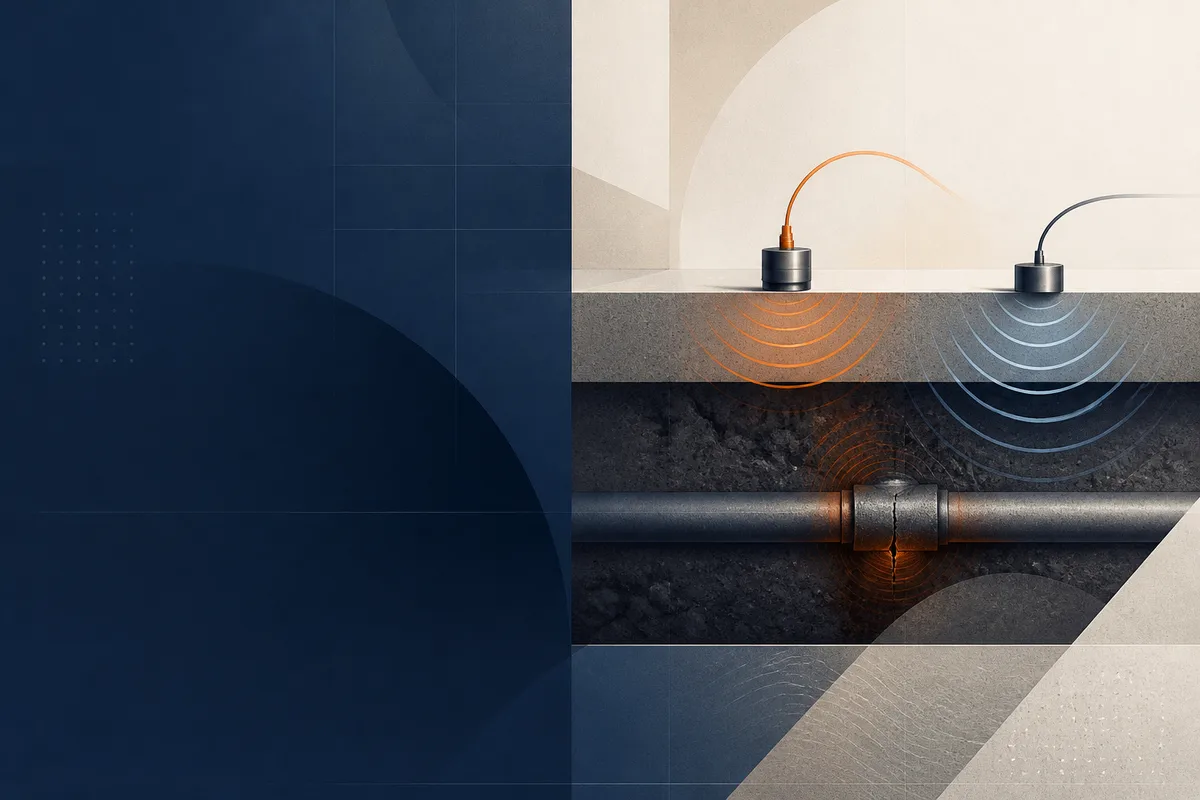
The Physics of Precision: Choosing Between Sound and Heat for Under-Slab Diagnostics
Homeowners often assume that a "hot spot" on the floor is the definitive location of a pipe failure. In reality, heat travels through concrete via conduction, often pooling several feet away from the actual breach depending on the soil's slope and the slab’s reinforcement. Choosing the wrong diagnostic tool results in unnecessary excavation, higher restoration costs, and prolonged property downtime.
This breakdown compares acoustic vs thermal leak detection to help property owners understand the trade-offs between speed and surgical precision. While thermal imaging provides a rapid visual survey of where water has traveled, acoustic imaging technology detects the sound of the leak itself, making it a reliable choice for non-invasive plumbing diagnostics when the goal is to pinpoint the source.
Why Visual Diagnostics Often Mislead Homeowners
Relying on surface temperature alone is a common failure point in residential leak detection. The physics of a slab-on-grade foundation complicates the path of both heat and water.
- Thermal signatures are easily distorted by sunlight hitting west-facing walls or heat radiating from heavy appliances.
- Water frequently travels along the exterior of the pipe or through the aggregate base before surfacing, creating a false thermal "hot zone."
- Concrete density varies across a single foundation, meaning heat may rise more quickly through a thin patch than directly above the leak.
- Thermal cameras can detect water leaks in insulated walls to some extent, but they rely on visualizing how moisture affects surrounding surfaces rather than the leak itself.
The Playbook for Accurate Sub-Surface Diagnostics
1Establish a Pressure Baseline
Before deploying sensors, the system must be isolated. A technician should monitor the water meter or a dedicated pressure gauge to confirm a drop that indicates an active supply-side breach. This step ensures that diagnostic efforts are focused on a pressurized failure rather than a drain line issue or local humidity.
2Map the Thermal Footprint
Thermal imaging is most effective as a preliminary scouting tool to visualize how moisture affects surrounding surfaces. By scanning the floor, a technician can identify the general area of moisture accumulation. This helps narrow the search area from a whole-house sweep to a specific room or hallway.
3Deploy High-Frequency Acoustic Sensors
Once the general area is identified, an acoustic water leak sensor is used to detect the sound of the leak itself. As water exits a pipe under pressure, it creates a distinct vibration. The technician moves the sensor in a grid pattern, looking for the point of highest intensity to pinpoint the break.
4Filter for Environmental Interference
In a desert environment, ambient noise from air conditioning units or traffic can interfere with leak detection. Professional-grade acoustic equipment is used to isolate the sound of escaping water. Acoustic detection tends to shine in situations where the plumbing is pressurized and the leak is actively flowing, allowing the operator to separate the leak signature from background noise.
5Verify via Tracer Gas if Necessary
In cases where a leak is too small to create a loud acoustic signature, or if the slab is exceptionally thick, a non-toxic tracer gas (nitrogen-hydrogen mix) can be injected into the line. The gas escapes through the leak and rises through the concrete, where it is detected by specialized "sniffers" at the surface.
The Sound-to-Signal Ratio: Why Acoustics Win
Acoustic detection succeeds where thermal imaging fails because it measures the source, not the symptom. When a pipe under a Scottsdale service area home fails, the water is forced out at city pressure. This force creates mechanical energy.
Acoustic sensors convert this energy into a signal for the technician. Because sound waves travel through rigid materials like copper and concrete, acoustic tools can identify the precise point of a pipe breach. Thermographic imaging technology, conversely, capitalizes on the thermal effects associated with leak phenomena, which may result in a large, amorphous shape that provides no clear center point for a surgical repair.
How Slab Leak Phoenix Helps
Managing a pressurized leak requires a methodical approach that begins with identifying the specific line at fault—whether it is the hot or cold supply. A standard diagnostic scope should include a full pressure test of the manifold system followed by a surface scan. Using professional methods allows a technician to identify the leak location before breaking any tile. Residents in Phoenix should prepare by clearing access to their water heater and ensuring the property is as quiet as possible during the inspection. A professional scope of work results in a specific marked-out section of the floor where the excavation will occur. For those ready to begin the process, calling (602) 555-0147 provides direct access to diagnostic scheduling.
Frequently asked questions
Does thermal imaging work on cold water leaks?
Thermal imaging is significantly less effective on cold water leaks because the temperature of the water often matches the ambient temperature of the slab. While it can sometimes detect moisture signatures, it often lacks the contrast needed for precision. In these cases, acoustic equipment is the primary tool for finding leaks under concrete.
How deep can acoustic sensors "hear" through a concrete slab?
Acoustic sensors are designed to detect sounds through pressurized supply lines and building materials. The effectiveness depends on the pressure of the water and the material of the pipe; copper transmits sound much more clearly than PEX or PVC. Technicians use these tools to pinpoint hidden water line breaks by following the sound of escaping water through the slab.
Why do I need a permit for slab-related plumbing work in Phoenix?
Major repairs involving the structural foundation or the replacement of main lines often require oversight to ensure safety and code compliance. According to the City of Phoenix, permits are a gateway to required guidelines for new home projects or property developments, ensuring that the work meets local standards.
Can I find a slab leak myself using a thermal camera rental?
Consumer-grade thermal cameras often lack the resolution to distinguish between a leak and a warm slab due to a poorly insulated water heater. Furthermore, without the ability to pressure-test the lines, a homeowner may misinterpret a hot spot caused by a "crossover" in a faucet rather than a break in the foundation.
How does Phoenix weather affect leak detection accuracy?
Extreme surface heat can make thermal imaging difficult during the summer months. High ambient temperatures can heat a concrete slab, which may influence the surface temperature readings used by thermographic cameras. According to the National Weather Service, the region experiences significant heat, making acoustic sensors a vital tool to ensure accuracy when thermal signatures are obscured by environmental conditions.
What happens when you get in touch: you describe the situation, we ask the few questions that actually change the answer, and you get a clear scope and next step — no obligation.